Plastic Free Market Gardening
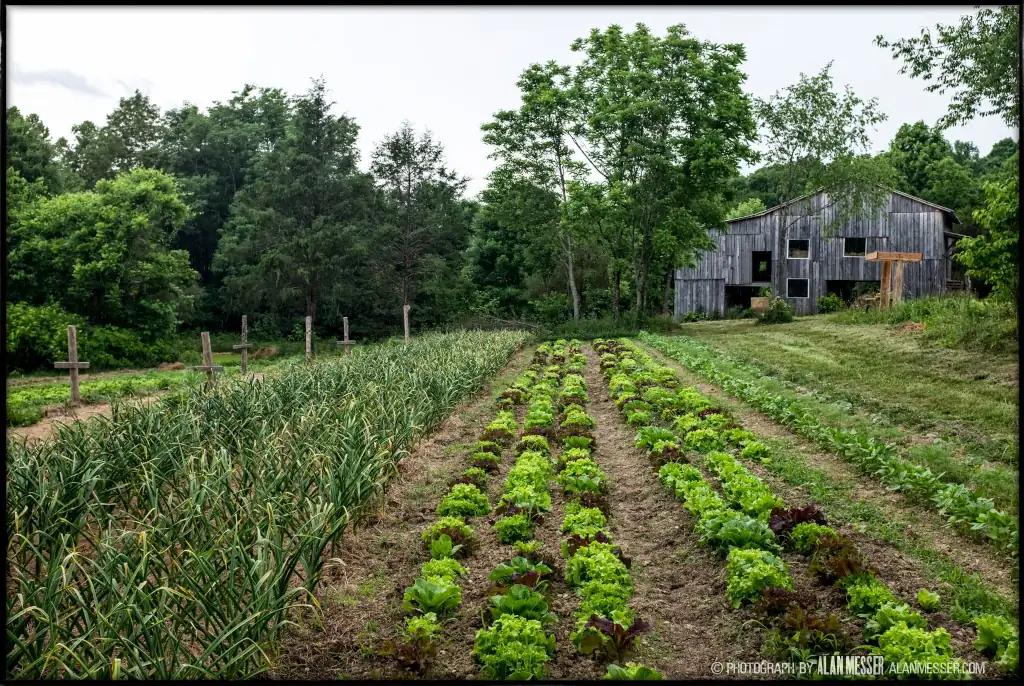
Can a modern organic vegetable farm succeed without the use of plastic hoop houses, plastic mulches, and plastic tarps, trays, bags, drip tape, and irrigation tanks? I can’t answer that question unilaterally, but I will attempt to explain how our farm managed to do it for the last 30 years or so. Along with about 40 head of cattle, we’ve grown 2 to 10 acres of market gardens for a large CSA, wholesalers, restaurants, and grocery stores. We found alternatives to plastic.
I need to rephrase that. Plastic in organic farming is the alternative. In the 1960s, greenhouses were glass; small tractors cultivated plants; plants were sold in burlap; and vegetables were handled in wooden crates, bushel baskets, and paper sacks. Milk was left at the front door in bottles, eggs came in cardboard cartons, and meat was wrapped in butcher paper. I don’t remember irrigation systems back then.
Farmers in areas with 40 to 50 inches of annual rainfall didn’t need to irrigate. They used common farming practices to collect, store, and utilize that rainwater throughout the year. Most raised both livestock and crops, keeping the land fertile and the scenery bucolic.
Plastics were perceived as a cheap but dubious replacement for wood, metal, and glass; materials which rot, rust, or recycle. Its permanence raised concerns because of the possible health effects on people and the environment when it deteriorates into smaller pieces. What began as just another petroleum product in the marketplace has since become pervasive beyond comprehension.
The amount of plastics used annually in agriculture is 12 billion pounds, creating over a trillion particles of microplastics. For reference, the difference between a million, a billion, and a trillion is the difference between 3 feet, 3000 feet, and 568 miles (3x1000x1000÷5280). Few people know this, although it’s taught in grade school. Plastic is everywhere, and its prevalence in organic farming seems incongruous with sustainable land stewardship.
Hoop houses are great for starting spring seedlings and for extending the growing season. The USDA gives them away, and many organic farms have installed them. I use cold frames instead, and sell in-season vegetables.
When I place a cold frame on fresh horse manure, it becomes a hotbed. The heat from decomposition warms the soil above it, which helps to sprout the seeds. Nightshades, in particular, appreciate the extra warmth. The horse manure needs to be damp and have litter with it, usually straw or sawdust, to aid in the fermentation that generates heat. A word of warning is required. Be sure a persistent herbicide was not used on the horse’s hay or straw. There are some on the market now that linger and will kill your plants.
I build boxes with cedar boards and cover them with old window sashes. A three-foot width accommodates most windows and is easy to reach into. I use 2x6s, sometimes adding an extra one on the north wall so the windows slope slightly to the south. I’ve also used bales of hay, logs, rocks, blocks, bricks, or any old board I can find to construct a cold frame. I thoroughly mix equal parts compost, sand, and garden soil together, along with a bit of lime, wood ash, and/or rock phosphate. Sand keeps the soil loose so the plants pull up easily. I soak the bed to sprout the first flush of weeds and rake it a few days later before sowing the vegetable seeds. A stick makes shallow furrows about three inches apart, and most seeds are dropped two inches apart in them. Lettuce and brassicas are sprinkled lightly in the rows. I firm the seeds into the moist soil with the side of my hand and cover them gently. Lettuce needs light to germinate, so it isn’t covered at all. I don’t water immediately after sowing because that would sprout weeds. Instead, the loose covering of soil dries out, and water rises from below through capillary action to sprout the seeds.
I uncover the beds during light rainfall, or sprinkle with a garden hose if necessary. Once the seedlings get their true leaves, I run my fingers between the rows, checking evaporation and disturbing weeds. Eventually, I spend a few hours pricking out weeds and keeping the soil loose. The windows are left off entirely as the weather warms. Lettuce and brassicas are sown in early March, and the nightshades a month later. A sweet potato bed is also made in early April, but all other crops are directly sown into the field.
Transplanting into a clean field begins by digging holes, removing a few shovelfuls of earth, and forking the soil at the bottom of the hole. The soil in the cold frame is loosened, and we pull the seedlings out gently, taking them directly to the field in buckets with water covering their roots. A quart or so of water poured into the hole makes mud, and we insert the bare-root plant into it, pulling dry soil over the top to keep the moisture in. Lettuce is trimmed before transplanting and watered afterward.
I chose to sell only in-season, outdoor-grown vegetables, feeling like that made for the best quality. It was easier, too. The first CSA delivery wasn’t until after Memorial Day, but we continued weekly right up to Christmas. In lieu of early crops, we produced large quantities in their respective seasons and offered our members enough extra vegetables to make pickles, can tomatoes, and freeze corn, beans, and greens at no cost. They could take as much as they wanted, storing up potatoes, sweet potatoes, and winter squash by the bushel. We had pesto parties and fermentation workshops, encouraging our customers to put up food for the off- season like we did ourselves.
So, a hoop house never interested me. Kale, spinach, and Chinese cabbage overwinter well in Tennessee, and I’m grateful for the time off from gardening.
In the early 1980s, I read about and tried the new method of black plastic mulching. Later, after hours of pulling it out of the grass growing around it and hauling it to the landfill, I had second thoughts. Small bits of plastic remained in the fields, forever I suppose. I want the edaphon, the plant and animal life in the top inch of soil, to interact freely with the inch of air directly above it. A sheet of plastic creating an impermeable barrier between the humus and the atmosphere might impede the beneficial effects of the live things crawling in and around the soil surface. Hay mulch made more sense, and a farm always has some that gets rained on or is leftover from last year. I certainly like grass string rather than plastic twine, and hay that’s been cut before it goes to seed is preferable. We use a curved fork to unroll the bale about halfway, and then push the center off to leave sheets which are carried to where it needs to go.
Sometimes we can get the roll to unroll. It gets fluffed up around perennials and in between beds of lettuce and other early crops. Fall cut hay will likely have warm season grass seed. We prefer this for garlic, as the seeds won’t sprout until next summer. Mulching the nightshades happens only after the ground has warmed sufficiently. Wood chips require years to rot enough to use as mulch. I wait until the wood totally disappears; otherwise, it will rob the soil of nitrogen.
As the market garden expanded, I began implementing the dry land farming techniques I learned from elders in my neighborhood, and a collection of farming textbooks from a hundred years ago. Both explained how to control weeds and produce crops without irrigation. Fields are chisel-plowed in the fall and sown with a cover crop mixture of grains and legumes. The grass family works with silica and finely divides the soil into small particles. The deep taproots of clovers, peas, and vetch bring air into the soil with the help of lime. Thirty tons of aged compost gets incorporated on each acre every year, and appropriate minerals, lime, and wood ashes are spread. It’s the combination of all these practices that creates a clay/humus complex and the good tilth necessary for moisture absorption, retention, and release.
Winter rains soak in, saturating the sponge like humus and filling the water table in the subsoil. The soil particles become surrounded by a film of water. After sowing the fields in the spring, the surface is kept loose by harrowing and shallow cultivation. This makes what we call a “dust mulch.” If we didn’t scratch the soil surface after every rain, the subsoil moisture would rise and evaporate by the action of the wind and sun. I cultivate with a Farmall 140 tractor, in the evening to conserve moisture or in the morning to create drier conditions.
Step on cultivated soil and your footprint stays moist while the loose soil around it dries. Water is leaving. By creating a dust mulch, we save an inch and a half of rain per week during droughts. Even after two or three months of hot, dry weather, you can push away the two inches of dry soil on top and the soil is moist underneath. This is because of capillary action. As the plants use the moisture near their roots, the soil there dries out. Subsoil moisture then rises through the film of water surrounding the soil particles, up to the dry soil around the plant roots. Moisture moves from dampness to dryness regardless of gravity, and this is how we water our crops. Moisture should only leave the soil through the plants by transpiration, never by evaporation at the soil surface.
Tillage has a bad reputation because it can easily be abused. I never rototill, beating my live soil humus to smithereens. I don’t invert the soil, and I’m careful about soil moisture. I till with loose, wiggly shanks, deeply in the fall, and shallowly the rest of the season. I promise Mother Nature that when I till I will repay the damage done with compost, cover crops, remineralization, and plenty of time for the soil to rest without tillage. No-till can become a limiting dogma, especially in farming. I like to say, “No-till until you need to till, then till until you can no-till’’.
I avoid the dogma of “no plastics” in several different ways. We sometimes cover fall crops with a poly-spun fabric for frost protection. The cattle are mob-grazed, and I have replaced metal wire with poly-wire, which is much easier to unroll, roll, unroll, and roll again and again. The metal pigtail posts are insulated with plastic, and I love five-gallon plastic buckets.
We harvest in bushel baskets rather than plastic crates or tubs. One of the parameters of the holistic management vision for our farm is aesthetics. I like the old-time look. Although plastic bags are handy for greens, I didn’t buy them. Instead, I ran a “conscience relief program” for people with plastic bag guilt syndrome; our customers brought their own recycled Walmart bags and plenty to share. We harvest greens early in the morning into the bushel baskets and kept them moist until the customers picked them up. I simply didn’t market to places that wanted vegetables in plastic bags.
Even my eyeglasses are glass, which surprised my last eye doctor. He only sold plastic glasses, which really should be called plastics instead of glasses. While maximizing organics, we have tried to minimize plastics, primarily because I don’t want to buy ugly stuff I’d have to throw away. Whether or not it’s efficient in today’s world, I can’t really say, but our gardens have enjoyed 50 fantastic, elastic, and somewhat spastic years of farming without plastic.