The Merry Prepstirs in Costa Rica
The Merry Prepstirs ride again! This time to the Pacific side of Costa Rica. Born from decades of work and study with Harvey Lisle, Hugh Lovel, and Hugh Courtney, we travel to farms to make and apply biodynamic preparations. Past adventures have brought us here before, to Villa Vanilla’s rain forest spice farm. Although the founder, Hank, has passed away, his son Chris and daughter Jenny have stepped up to carry it on. Chris keeps busy with tours and marketing, Jenny manages production, and we’ve come to help.
After the obligatory ocean swim and sunset, we met up with Danielo at the farm. He had a tub full of cow guts fresh from the abattoir that needed attention. Procrastination was out of the question. The age-old conundrum of deciding which mesentery to use was easily solved. As locals make dishes out of the net mesentery, we were left with the task of separating the isles of mesentery from the intestines. I’d only done this once, 20 years ago, when we hosted the national BDA conference and had a freshly slaughtered cow. They pull apart much easier when still warm. We slowly and gently pried them apart, finishing Friday night with enough material to fill with the dandelion we’d brought. Late night planning for the weekend workshop was heartfelt and the details were forgotten by morning.
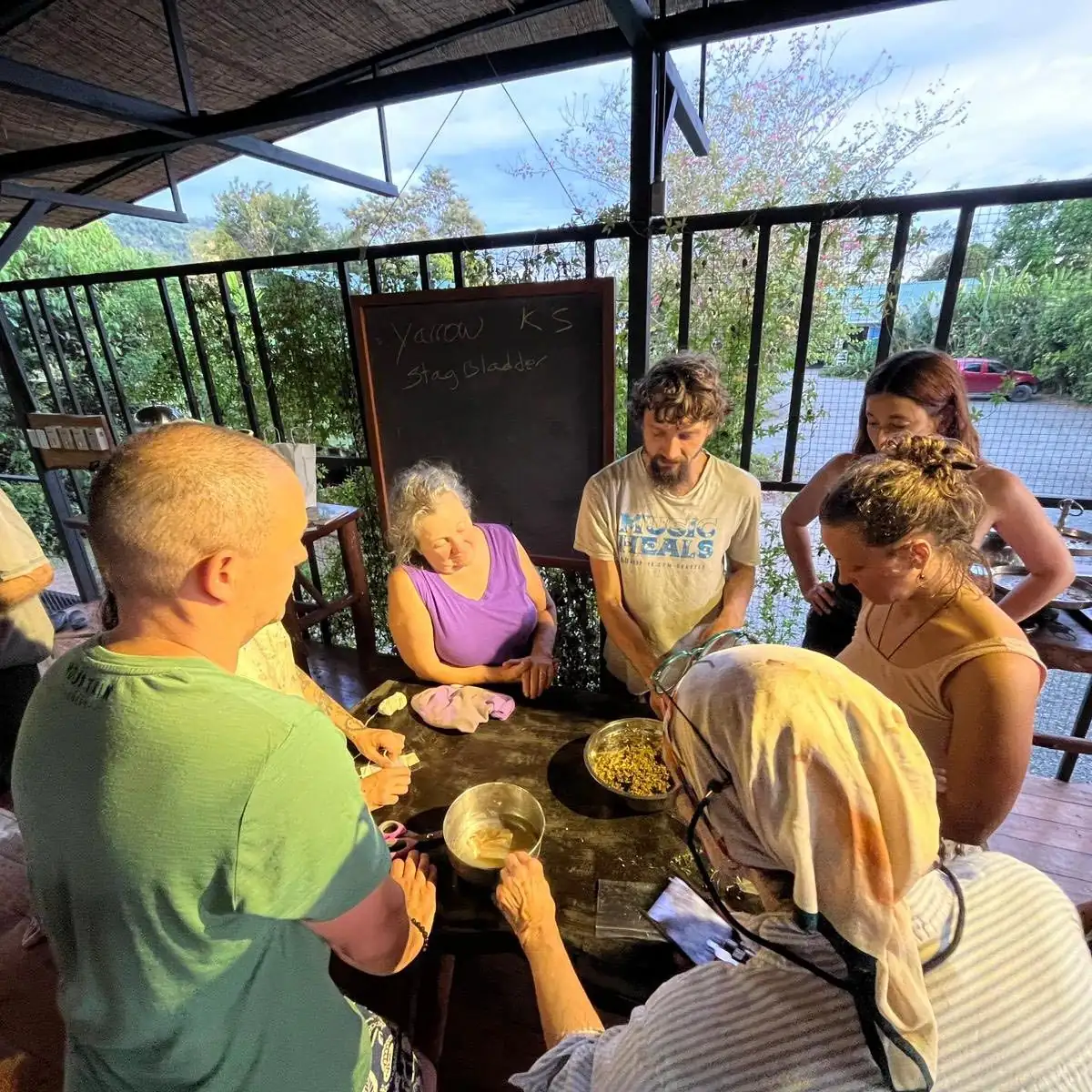
Our group included Jairo and Rona, just beginning their farm in Costa Rica after 40 years of working at the Pfeiffer center and Weleda in New York. Their intern, Ushi, supplied the inevitable thread of interconnections we continually encounter. Her Taiwanese friends had interned in Japan with Ben and Konomi, who had met and married while interning on our farm 18 years ago. We also had a local homesteader, a few of Jenny’s friends, and a gardener from Ireland named Paulo. “We” included me and two biodynamic farmers from Virginia, Ben Nommay and Allie Milam. After introductions on Saturday morning, I subjected all to two full days of lectures and demonstrations.
Just like Rudolf Steiner did 100 years ago, we began by explaining why the oxides of silicon and calcium are so important for growing high quality food. Steiner grew up in the latter part of the 19th century, during the culmination of pre-chemical agricultural knowledge. He left his rural roots to receive doctorates in biology, chemistry, and mathematics, but maintained that he learned more from the peasants of high youth than his subsequent University training. He also claimed in 1924 that he could not find potatoes that tasted as good as those he ate growing up. He blamed this on the use of chemicals, which interfere with the natural processes active in plant growth.
Silica forms the sheaths of the vascular bundles in plants and the mycelium of fungi, which are the “tubes”, so to speak, of the plants’ nutrient transportation system. Calcium bonds with the nutrients needed for plant growth and carries them through these tubes. To offset the negative repercussions from chemical use, Steiner’s early biochemistry studies led him to recommend two homeopathic field sprays, which we proceeded to make.
We filled one set of cow horns with fresh cow manure and another with finely ground quartz crystals. The former helps the formation of a stable clay/humus complex so that lime can easily access soil minerals in the colloidal state. The latter strengthen the surface of the tubular structures of the fungal hyphae in the soil and the vascular bundles in the plant. Experience has shown that when this nutrient transportation system is thus brought back into proper functioning, the resulting plant growth is resistant to disease and insect pressure, and that the food is nutrient dense and very tasty.
A factor contributing to the flavor is the ability of humus to supply the plant with amino acid nitrogen. This is the form of nitrogen that plants use. When nitrates from chemical fertilizers are applied, the plant must use energy to convert it to the amino acid form. Energy in a plant is in the form of sugars, so these plants will have less sugar, not taste as good, and be less able to ward off insects and disease. Nitrogen comes from the air into the soil through tillage, root growth, and holes made by tiny animals in the soil (like earthworms). Sugars enter through photosynthesis and root exudates. A rich, humus soil allows for inert atmospheric nitrogen to become part of the soil life, for trace elements to become chelated and available, and for the ionic exchange of hydrogen for the hard elements like potassium and magnesium. You can see why Steiner stressed the application of “humus, and humus again.”
These processes can be strengthened with homeopathic humus products that work with the elements needed for healthy plant growth. We had snuck in a few stag bladders and yarrow flowers – items hard to obtain in Costa Rica. We packed the yarrow into the bladders tightly, wrapped it in copper mesh and hung it in the sun. They’ll be buried later, and when dug, added to compost piles to eventually help enliven the potassium and sulfur activities in the soil. We then stuffed smuggled chamomile into the cow intestines and made three sausages, to also help with the calcium processes in the soil. A lively discussion followed about stinging nettle and possible substitutes from local “stinging nettles” that were not Urtica dioica. We noticed another nettle variety in a garden tour a few days later, and saw dandelion, yarrow, horsetail, and white oak trees growing up in higher mountainous elevations. All of the preparations made from plants are added to compost piles.
A discussion about the oak bark preparation was prefaced by the need for calcium from something alive to help plants resist diseases. We did not have a freshly harvested cow skull available to make this preparation. Next, Danielo added the dandelion flowers he’d gathered to the ones we’d brought, and we sewed them up into the mesentery. Contrary to the way I do it in Tennessee, they hung theirs up like we did the bladder, whereas I bury them directly. A talk ensued about the hidden alchemy involved with the elements of potassium, calcium, hydrogen, silica, and iron, and the work they do creating amino acid nitrogen.
Valerian’s work with phosphorus wrapped up our Sunday afternoon discussions, and we buried the cow horns with silica on Monday morning. Along with delicious tropical meals, the requisite biodynamic music, and fascinating plant walks, we also enjoyed trips to the beach and river. Pura vida!
Biodynamics reeks of “woo-woo”, which is off putting for some potential practitioners and immediately shuts doors. We felt it important to distinguish between the peasant wisdom and celebrations Steiner was drawing from, which are not unlike practices of indigenous peoples everywhere, and a ritualistic, unscientific approach. Although we imbue practical farming with Steiner’s insight, the results are not based on faith but on our own experiences.
Farms worldwide benefit from learning and working with the forces involved in plant and animal growth. Although the preparations play a central role, they were only mentioned in two out of Steiner’s eight agriculture lectures. A tactful approach to introducing biodynamics requires a consideration of the audience, particularly the farm workers. Fortunately, there are many avenues for understanding. We can look at biochemistry, microbiology, energy, nutrition, regenerative grazing, humus formation, ancestral knowledge, biological transformations, astronomy, annual cycles, nutrient recycling, and the balancing of crop production with animal husbandry, reforestation and all the other essences of good farming, meanwhile merrily stirring preparations.